
“Am I warm or cool?” It is the question I hear most, often before anything else. Many women ask me after trying three tests online and getting three different answers.
So here is what those tests check, why they disagree, and what really gives you the answer.
If you search this question, you find the same few tests on almost every page:
They are a starting point, not an answer. Each one looks at one small detail, in whatever light you are standing in, and asks you to judge yourself. That is why they so often disagree with each other.
Olive skin has a yellow base. Every quick test will call it warm. But many women with olive skin look their best in cool colours. In my method we call this the “false warm”. It is very common in Perth, where so many of us have mixed heritage.
Here we live with strong sun most of the year. A tan makes the skin look more golden, so it is easy to think you became warm over summer. You did not. A tan comes from melanin, and it does not change your temperature.
The opposite also happens. Some women with warm colouring have skin that looks a little pink. If you only look at the pink, you will go cool, and you will spend years in colours that make you look tired.
I hear some version of this in many sessions. A woman has decided long ago what her undertone is, because of one sign: a foundation that never looked right, a gold ring she loves, a friend who told her.
Emily, a client of mine, said exactly this. She had always believed she had a yellow undertone, because pink foundations never looked right on her. In the drapes, she was clearly cool. She was not wrong to notice the foundation. She was reading the wrong sign.
Most of us decide this about ourselves from one detail, and then we shop by it for years. That is why the answer can feel so surprising.
This is the part most pages leave out. Your colouring has three qualities, not one:
Your season comes from the mix of the three. (All twelve seasons, and what leads in each one: What season palette am I?) And for many women, temperature is not the strongest one. For a Soft Summer, the most important thing is softness. For a Bright Winter, it is brightness.
If you have tried every test and still feel “in between”, this may be why. You may be what we call neutral warm or neutral cool: you still lean to one side, but temperature is not your main feature. So the question “warm or cool?” cannot give you a clear answer on its own.
I use the Brazilian twelve season method, and in it temperature is never decided by one sign. It is decided by comparison.
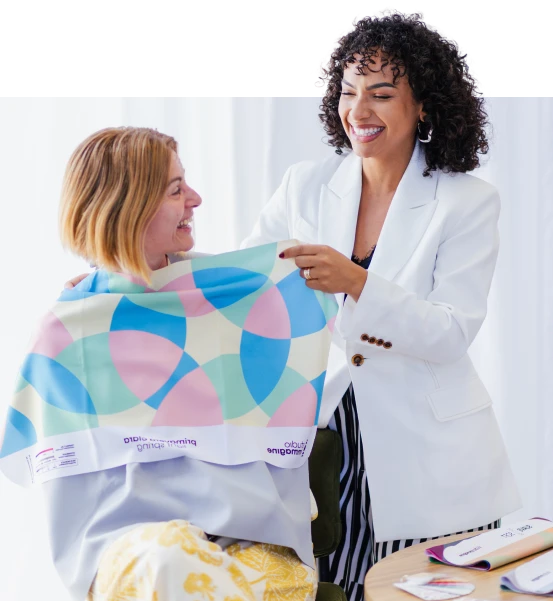
First I look at your contrast, your depth and your intensity. Then temperature, in three steps: warm against cool fabrics, then a second set that looks closer at your undertone, and finally a set of reds that shows if your temperature is a main feature or a second one.
I prefer natural daylight. When the day does not give it, I use my mirror with calibrated light, so the light stays the same for every colour. Real fabric goes next to your face, one colour next to another. You see the difference yourself. And I never ask which colour you prefer, because what you like and what suits you are different things.
If you want to see the full method, it is here: How colour analysis works.
You can find out. Not from your veins, and not from a screen, but from a comparison done in the right light, with someone trained to read it. When you know, you will see it every time you get dressed.
If you are thinking about booking, I answered the questions I get asked most here: Before you book a colour analysis in Perth. And when you are ready, come to my home studio in Stirling, or I can come to you anywhere in Perth: Colour analysis in Perth.
Let’s glow! ✨