
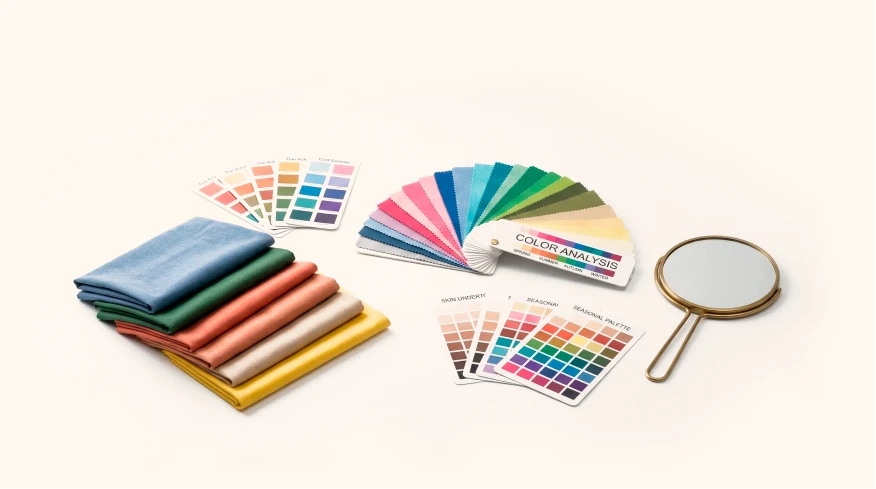
“What season palette am I?” If you are asking this, you have probably already tried a quiz or two. Maybe one said Autumn and the next said Summer.
That is very normal. Here is how the seasons really work, how you can get a first idea at home, and why the answer is often a little different from what you expect.
Most quizzes give you one of four answers: Spring, Summer, Autumn or Winter. It is a good start, but four groups are too wide. Two women can both be “Autumn” and still look their best in very different colours.
In my method there are twelve seasons, three inside each of the four. What makes them different is your main feature: the one quality that matters most in your colouring.
Every colour, and every person, has three qualities:
Your season is the mix of the three. And in each season, one of them leads.
You can see that the seasons next to each other share something. A Soft Summer and a Soft Autumn are both soft. A Bright Spring and a Bright Winter are both bright. This is why so many women feel “in between” two seasons.
You can start to find your direction with three questions. Stand near a window, with no makeup, and look at your face, not your clothes.
Also look at your contrast: the difference between your skin, your hair and your brows. Fair skin with very dark hair is high contrast, and it points to Winter, Dark or Warm Autumn, or Bright Spring. Soft, close tones point more to Spring, Summer or Soft Autumn.
These questions give you a direction, not an answer. Your own eye is used to your face, and the light in your home changes the colours. A tan, olive skin, or hair you have dyed for years can all send you the wrong way.
Many women arrive at a session sure of their season, and leave with a different one. Not because they were wrong to notice things, but because they were looking at one sign alone.
In a session, nothing is decided by one sign. I look at your contrast first, then depth, intensity and temperature, always by comparison: one fabric against another, under natural daylight or my calibrated mirror light. Your season is the one that keeps winning, step by step. (More about this here: Why online colour tests don’t work.)
And knowing your season changes more than your clothes. It also helps with your makeup and your hair. (If you are thinking of going blonde: Which shade of blonde is right for me?)
If you are tired of quizzes that disagree, you can find out once and for all. You will see each colour on your own face, and you will leave knowing your season and your palette.
The sessions are here: Colour analysis in Perth. Sessions are at my home studio in Stirling, or I can come to you anywhere in Perth.
Let’s glow! ✨